
AstroFM
An AI driven music streaming App for Gen Z users struggling with algorithm fatigue
AstroFM is a mobile app I co-designed in a 3-month sprint with PM and engineers. I joined during early ideation and led product thinking, user research, and interaction logic design.
Later on with hands-on wire-framing and prototyping , I delivered the product MVP with another UX designer in group. I also participated in back-end prompt logic framing and front-end QA support during delivery.
My Role
UX Designer
Research Lead
Concept Lead
Design‑to‑Dev Liaison
Team
1 Project Director
1 Product Manager
2 UX Designers
2 Front-End Developers
2 Back-End Developers
30 Sec Insight
AstroFM is a mood-aware AI music app designed to deliver emotionally resonant recommendations using mood input and symbolic astrology.
Project Highlight
Reframed recommender UX from algorithmic precision to emotional resonance
Designed a 3-step daily ritual: mood check-in → symbolic AI interpretation → music delivery
Structured a symbolic system with minimum input & poetic explanation
Impact
Built a ready-to-ship MVP with PM and full-stack team
Created 4 core features: Mood Input, Symbolic Recommendation, Emotional Calendar, Identity Page
Initiated team-wide discussion around algorithm explainability and user emotional trust
What I Did
Brainstormed 5+ product directions and design proposals
Led the research process through 4 in-depth competitor analyses and 20+ qualitative user research.
Created interaction flows that shaped MVP structure and feature split
Co-designed wireframes and prototyping with another UX designer
Skip to Solution Overview
↓
What we want to do
We were asked to design an AI-powered music recommendation product that could launch within 3 months and drive daily user engagement.
But we didn’t want to build another utility—our goal was to create an emotionally resonant experience.
Design an AI-powered personalized music streaming app
Create and launch a working MVP in 3 months
Drive consistent daily engagement among users
The problem
Assumption
Why aren't today's recommendation systems satisfying?
Even when algorithms are accurate, users don’t feel understood.
Validation
To validate our assumption, I distributed a short screening survey (n = 300, age 18–35) to identify frustrated users.
Then, I conducted 20 in-depth interviews to explore their emotional friction points and media habits.


What We Heard


Insight Summary
Most recommenders optimize for past behavior, not emotional state.
Symbolic systems offer a poetic, emotionally intelligent alternative.
💡 There’s space for a new kind of recommender: emotionally resonant, not just accurate.

What kind of product we want to build

A music app that understands how you feel—before you know what you want.
We designed it as a daily emotional touchpoint—blending mood input, astrological reflection, and symbolic AI recommendations.
Instead of asking “ what do you want to listen to? ” AstroFM starts by asking: “ how are you today? ”
Why astrology? Why mood input?
When users feel lost, they don’t want precision—they want resonance. Symbolic systems like horoscopes help frame feelings, not solve them. By combining these with gentle AI interpretation, we offer a new kind of experience: ritualistic, intuitive, and emotionally intelligent.
Product Vision: A symbolic recommender that speaks your emotional language.
AstroFM uses minimal input to generate emotionally resonant content through symbolic logic—starting with music, but extensible to other forms of expression in the future.
Product Showcase
We brought the symbolic recommendation ritual to life through three core modules.
Tell your mood - Mood Input
A quiet space to express how you feel — through shapes, color, slider, or keywords.
Why this matters
Users often don’t know exactly what they want. Mood input opens a space for emotional projection, setting the tone for symbolic reflection.
Symbolic Recommendation
Each day, the system interprets your mood and offers 3 symbolic songs with poetic captions.
Why this matters
Instead of predicting based on behavior, we generate resonance based on emotion — turning recommendations into daily rituals.
Emotional Calendar
An archive of moods and music — helping users reflect on their emotional journey over time.
Why this matters
Mood-based content becomes a form of personal memory — building a timeline of how you've been feeling.
Concept Ideation
🔍 Insight | 🧩 Feature Response |
|---|---|
Users don't know what they want to listen to | Mood input guide + automatic astrology interpretation |
Users want to feel "seen", not analyzed | Symbolic recommendation cards instead of analytical labels |
Users enjoy a daily "ritual" experience | limited and exclusive recommendation per day with poetic captions |
Users want to reflect and revisit emotional states | Emotional calendar to track and reflect on moods |

Our Design Principle
1. Emotion Over Precision
We don’t aim to be right—we aim to resonate.
2. Symbolic Interaction
Recommendations should feel poetic and metaphorical.
3. Minimal Input, Reflection
Light-touch UI allows introspection without overload.
4.Daily Ritual, Not Utility
One interaction per day to establish a reflective rhythm.

1. Welcome & Onboarding
Sign up using birth date & location
Generate a natal chart
2.Daily Check-In
Mood input
Combined with astrology to interpret the current state
4.Daily Ritual, Not Utility
One interaction per day to establish a reflective rhythm.
3.Emotional Calendar
View previous moods & recommendations
4.Explore Others (in development)
See anonymized suggestions from other users
Enable mood resonance across users
5. Compose a song with daily guidance (in development)
Invite participants in music generation
Make the mood resonate into one outcome
WIreframe & User Flow
I proposed the 4-module structure early in the design process to map mood input, symbolic logic, and user reflection.
We started with wireframing each section. Since we want a distinct, innovative, and straightforward app, 2 UX designers came up with different ideas and finalized the design together.
Motion Input - Daily check in


❌ Why these versions didn’t work
✅ Why this version was kept
We explored multiple approaches to mood input—from specific emotion options to a quadrant-based chart. While visually distinct, both failed to balance clarity and flexibility in user testing.
The final design strikes a balance between expression and simplicity.
We used categorical moods with adjustable intensity and merged mood + context inputs into a single streamlined page.
Mood Input - the flow


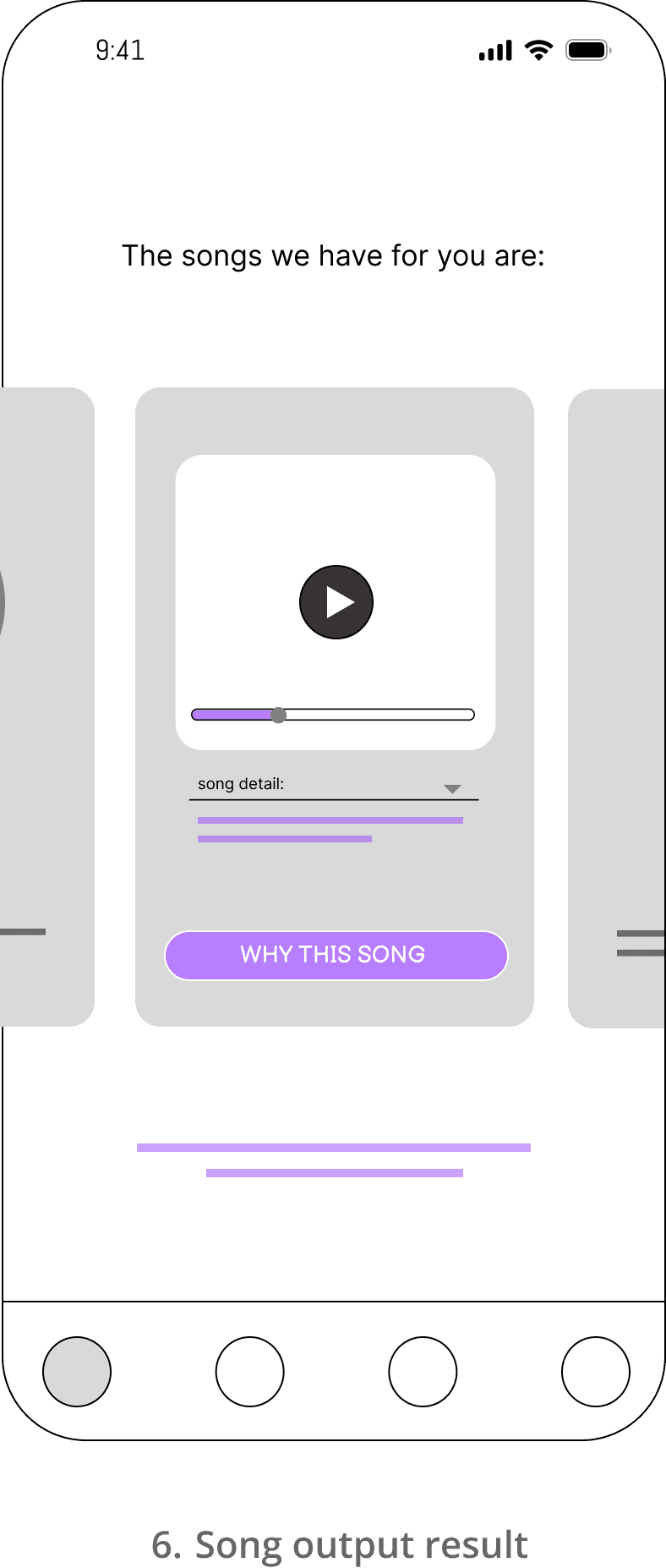

Compose - Generate A Song with the Stars ( future update )


Users compose a song with the " stars " and generate it with AI
Mood Tracking - Calendar


The calendar flow allows users to track their mood. The page differs if the mood input is in use or if it has never been used that day.
Me Page - Settings


The Me page is for personal information, general astrological information, and settings
Final Design Deliverable


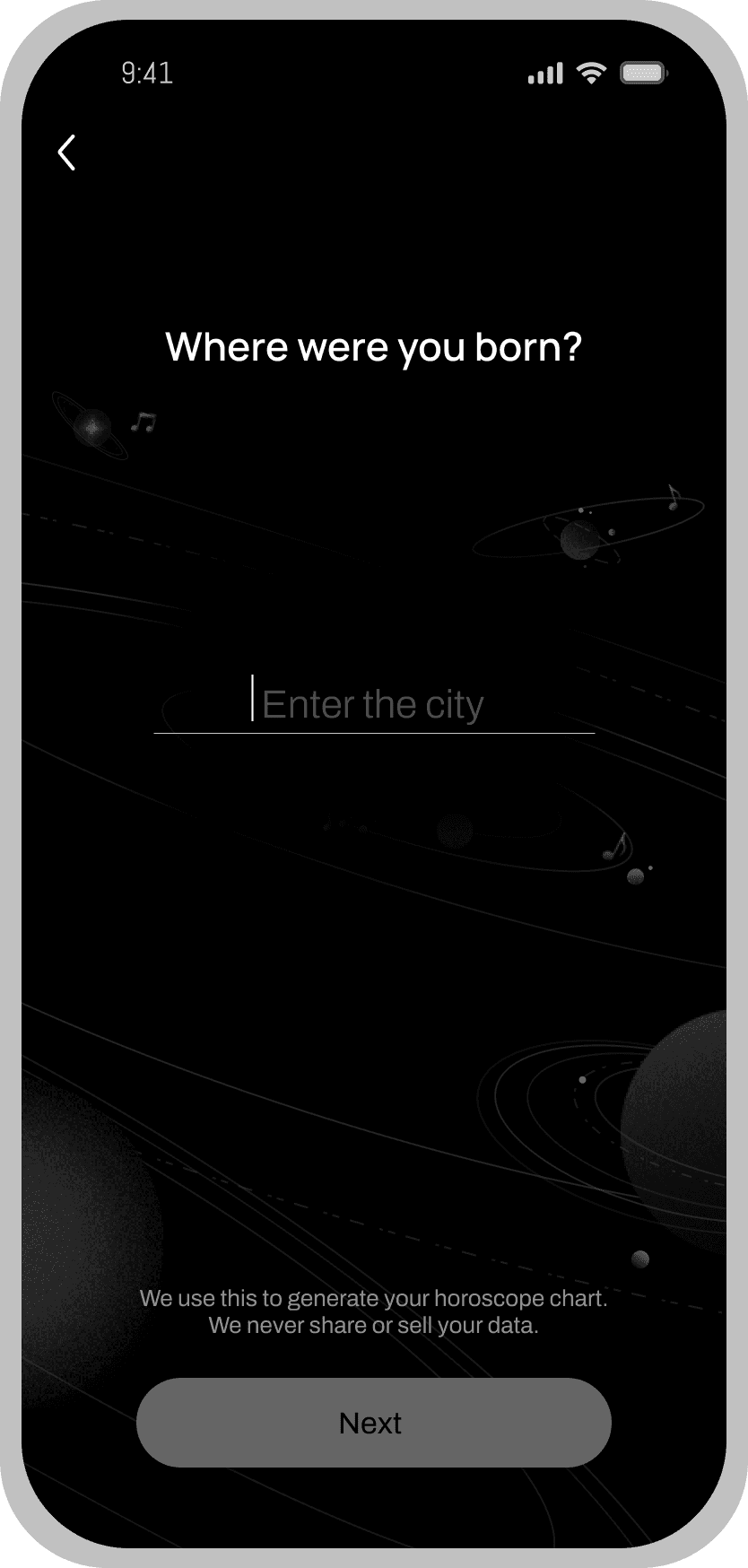


In case the user wants to revisit previous content, we allow a skip entrance. The sliding bar enables the users to be more specific on their mood input.


The Calendar page contains a track of use history, a song list for each day, and allows users to track back their mood pattern. Liked songs are also hosted on this feature.


The Calendar page contains a track of use history, a song list for each day, and allows users to track back their mood pattern. Liked songs are also hosted on this feature.


All personal information and settings are contained in this feature.


